How Generative AI Engines Impact SERP Visibility And How to Optimize for Them

Your content might be showing up in search results without anyone actually seeing it.
That’s the reality as generative AI engines like Google’s SGE and Bing’s AI-powered answers reshape the search landscape. These tools aren’t just ranking pages. They are summarizing, paraphrasing, and, in many cases, answering user queries directly on the SERP. That means fewer clicks, less traffic, and a growing disconnect between rankings and real visibility.
This shift has significant implications for organic search. Traditional SEO tactics that once guaranteed exposure are no longer enough. It’s not just about where you rank — it’s about how your content is interpreted, surfaced, or even replaced by AI-generated summaries.
In this article, we’ll unpack:
- What GEO is and is not
- How Generative AI is impacting traditional search
- When to start optimizing for AI responses
- How to optimize for different types of AI search engines
- GEO implementation tactics
Let’s dig in.
What Generative (Search) Engine Optimization is Not
Generative Search Optimization is not search engine optimization (SEO). But it isn’t all that different.
As of now, there’s a massive overlap. That’s why you’ve probably heard: “GEO is the new SEO”, and “It is the modern SEO”. Or a personal favorite that always comes back in style, “SEO is dead; GEO is taking over.”
That’s an oversimplified take because it’s more nuanced.
SEO involves optimizing your website to surface the right content for customers searching for solutions on search engines. If all goes well, this SERP visibility ultimately leads them to your website to learn more. However, GEO only grants you visibility if and when your brand, product, or services become a part of its conversation with users.
In essence, they already differ in their core priorities, with traditional SEO optimizing for and pulling content from ranked search results and GEO synthesizing responses from multiple sources.
Beyond this, we recommend looking at SEO and GEO differently because:
- The execution and success KPIs are different.
- Visibility on LLMs like Perplexity and Claude is secured through mentions and not link building.
- Generative AI is conversational. Therefore, you’ll need different content optimization tactics and structures for them. This is fundamentally different from content for search engines and can also differ based on the generative AI model you’re optimizing for.
We’ll touch more on some of these points within the article, so keep reading. In the meantime, generative AI is an evolving technology, so this may not be true forever.
As Ryan Law said in a recent LinkedIn post, “There may be more divergence, but equally, as more LLMs start using ‘traditional’ search indexes, there may be less divergence, and the boundaries between SEO and LLMO will become even smaller, or nonexistent.”
SEO vs. GEO: Quick Comparison
| Category | Traditional SEO | Generative SEO (GEO) or Answer Engine Optimization |
| Goal | Rank pages on SERPs | Get cited in AI-generated answers |
| Optimized For | Search engine crawlers (Google, Bing) | AI models (LLMs, ChatGPT, Perplexity, etc.) |
| Outcome | Visibility through clicks and links | Visibility through mentions and summaries |
| Attribution | Mostly explicit (links in SERPs) | Often implicit or partial (may lack links) |
| Strategy Focus | Keywords, backlinks, and technical SEO | Authority, clarity, citations, structured data |
What is Generative Engine Optimization (GEO)?
Generative Engine Optimization (GEO) — also called Answer Engine Optimization (AEO) — is the practice of optimizing your content to appear in AI-generated answers from tools like:
- Google’s AI Overviews
- ChatGPT (with browsing or plugins)
- Perplexity
- Bing Copilot
The goal is to influence AI search engines and LLM tools to position these entities as relevant enough for their automatically generated answers to a person’s question. To do this, you’ll need to embed your brand, data, and expertise into the knowledge base and training sets of AI models.
However, how you go about this will differ according to the type of AI-driven search system you’re optimizing for (more on that in a bit).
How is Generative AI Impacting Traditional Search?
Generative AI has changed traditional search behaviors. We’ve gone from searching for pretty basic keyword queries on traditional search engines to crafting hyper-specific prompts for a more contextual answer.
User interactions are now leaning more toward conversational queries, causing Google (and Bing) SERPs to evolve and integrate generative AI models into their search experiences. This ‘merchandises’ content in a way that keeps users locked in on the SERPs (i.e. not directed to ranking websites) for longer.
1. Better Understanding of Search Intent
Generative AI interprets the meaning behind queries, not just the keywords. This allows it to deliver more accurate, relevant answers—even when phrased in different ways.
Traditional search engines mostly rely on keywords, backlinks, and basic query matching to deliver results. But generative AI goes deeper. Instead of just matching terms, it tries to understand what the searcher wants, even if they don’t phrase it perfectly.
Here’s how:
- Context over keywords: Generative AI can interpret the meaning behind a query, even if it’s vague or conversational. For example, a query like “how to grow an SEO agency without burning out” might return a mix of content in traditional search. But generative AI knows you’re looking for sustainable strategies, not just growth hacks.
- Follow-up potential: AI-powered engines often encourage follow-up questions, using your previous queries to shape better answers. This helps refine search intent in real time, something traditional SERPs struggle to do.
- Multi-intent understanding: Some queries have layered intent. For example, “best tools for local SEO” could mean research, buying, or comparison. Generative AI is better at recognizing these layers and offering more targeted results that reflect those nuances.
2. New Search Experiences
Generative AI changes how results are delivered — from a list of links to direct, conversational answers. Users get summaries, comparisons, and recommendations without clicking through multiple sites.
Rather than the rigid phrasings typical of traditional search experiences, people can interact in natural language via conversational queries on Gen AI platforms. This encourages smoother, human-like interactions that are accessible to everyone.
Additionally, AI-driven search features synthesize citations from various sources into a cohesive, relevant, and coherent answer.
With Google’s SGE, for example, the answer appears as a snapshot at the top of the SERPs or “position zero,” with sources listed at the right.
Google’s SGE snapshot at position-zero
Other platforms like Perplexity include follow-up questions and expandable sections as suggestions for a richer experience.
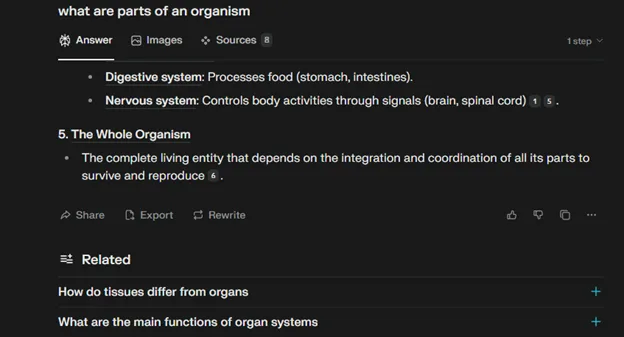
Perplexity AI-generated summary with FAQ and expandable sections
This drastically cuts the time spent searching for crucial information, as it sometimes surfaces related content you didn’t even know was relevant. Hence, it is easier to find new ideas, trends, and knowledge.
3. Disrupts Organic Traffic Patterns
Visibility on the SERPs used to mean a strong chance of earning clicks and organic traffic. If you landed a featured snippet, even better — your content stood out and drove results.
But that’s changing. Featured snippets, once owned by a single source, are being replaced—or blended—into AI-generated summaries. As a result, click-through rates are dropping.
Why? Because for simple queries, users no longer need to leave the SERP. They get their answer instantly and move on.
It doesn’t matter what their choice of AI-powered search platforms is. You’ll see a similar search pattern on ChatGPT, Claude, or Gemini, where generated responses are direct and contextual. AI chatbots like these bypass the traditional search-and-click model entirely, further fragmenting organic traffic sources.
That said, more marketers are starting to notice better conversions from the traffic they get from ChatGPT and Perplexity. These high-quality visitors were already well-informed from the answers obtained from the LLMs, thus making them more likely to engage on their website.
4. Changes SERP Real Estate and Visibility
Ranking on the first page used to be the goal. But with generative AI taking up prime real estate on the SERP, even a top organic spot doesn’t guarantee the visibility it once did.
Here’s why:
- AI-generated answer boxes now appear above organic listings for many queries
- The traditional “ten blue links” format is becoming less prominent
- Featured snippets now compete with—or are replaced by—AI summaries
Knowledge panels and rich results are squeezed alongside expanded AI content
In short, we’re no longer competing with other websites for the top spot. We’re competing with the search engine itself.
Both Google and Bing are also filling space below featured snippets with new content formats, like subreddit threads, videos, and “People Also Ask” sections. What used to be a clean list of links is now a crowded, AI-curated content hub.
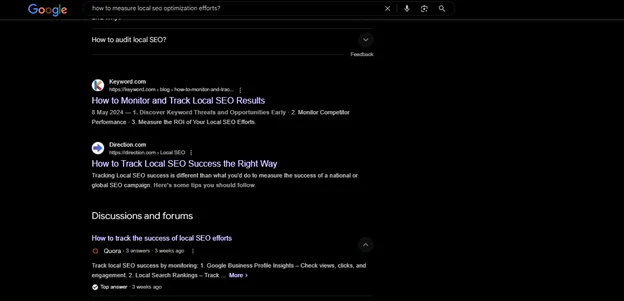
SERP changes on Google
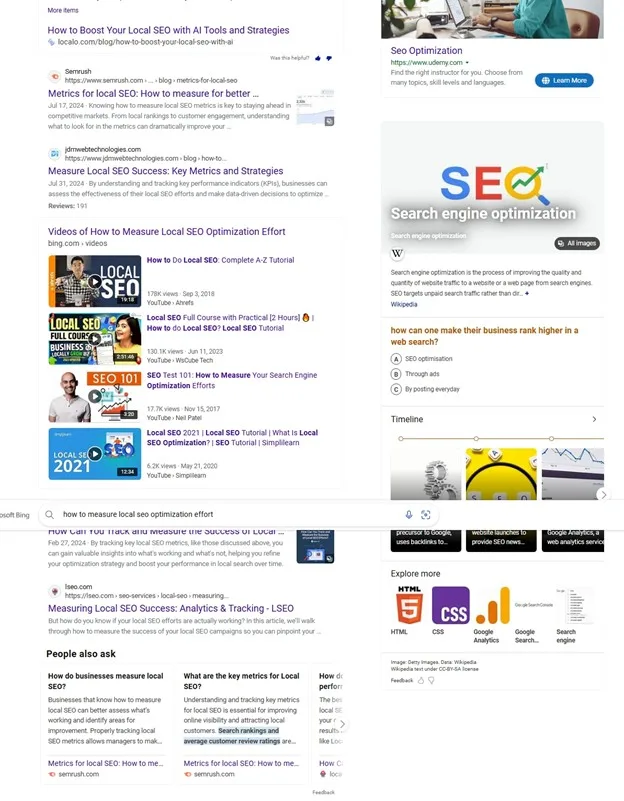
SERP changes on Bing Search
As a result, searchers get more answers while staying on the search platform for more information.
When Should You Start Optimizing for AI Responses?
The best time to start AI optimization was in 2023; the second-best time is now. To stay ahead of evolving search trends, you should bake AI optimization into your strategy. Here are three considerations to have:
1. If AI Answers Are Affecting Traffic and Visibility
If organic traffic has dropped due to AI-generated responses appearing at the top of search results, it’s time to rethink content strategies to make sure brands stay visible.
Tyler Hakes of Optimist says:
The main thing for brands to do is some kind of an AI audit.” Basically, just start by assessing their visibility for their most important topics and a small sample of questions that a real customer could use (e.g., productivity software).
If they’re already appearing relatively well, then I’m not sure we have enough data to invest much time and effort in truly “optimizing.” But if they aren’t showing up at all, then it’s probably time to assess what needs to happen to start to appear.
2. If Your Competitors Are Getting Featured in AI Results
If AI search tools are pulling answers from your competitors instead of you, analyze why and adjust your content to increase your chances of being cited.
Look at the pages being pulled into AI summaries. Are they blog posts, product pages, guides, or FAQs? What’s the format? What’s the tone? Pay attention to how they’re structured and whether they directly answer the query in a concise, authoritative way. Then implement the learnings in your content.
3. Before AI Becomes the Default Search Experience
Currently, Google’s generative AI experience is still being tested in limited ways. It’s not yet the default for every user or every query, but that window won’t stay open forever.
When AI results become standard across more searches, the shift will be fast, and the impact will be significant. Agencies that wait until that moment to adapt may find themselves scrambling to regain visibility, while their more proactive competitors dominate key SERP real estate.
That’s why now is the time to act.
By optimizing early for generative AI, you’ll have the time to:
- Experiment with content formats that are more likely to be cited
- Test what types of structure and phrasing AI prefers to pull from
- Refine your workflows to include generative optimization alongside traditional SEO
- Establish topical authority before your competitors even realize it matters
How to Optimize Content for Different Types of Generative AI Search Engines
Here are the three categories of AI-powered search systems and how to optimize content for them.
1. Training-Based Systems (e.g, Meta AI , ChatGPT offline, Claude)
Training-based AI search systems pull responses from snapshots based on their training data, a limited knowledge library with a cut-off date. These snapshots stay frozen in time until the next update.
To influence training-based models, think long-term by using consistent, evergreen strategies.
- Publish timeless content: prioritize evergreen, authoritative information that stays relevant beyond the model’s knowledge cut-off date.
- Secure brand mentions: focus on digital PR and getting your brand mentioned in highly indexed sources (high-trust publications, reputable news outlets, and industry databases).
- Get reviews and recommendations: similar to brand mentions, reviews matter because they convey positive sentiments. Have clients leave personal reviews on your website and third-party review platforms like Capterra, Trustpilot, Google Reviews, etc.
2. Real-Time or Search-Based Systems (e.g., Perplexity, Bing AI, AI Overviews)
These models generate responses in real time by crawling indexed web content. Therefore, if you’ve got your traditional SEO tactics down, you can also win visibility on these platforms by influencing what they find about your brand in Search.
To do this, home in on immediate fixes and updates, like:
- **Keeping things fresh with timely updates:**got new research or product info? Publish it immediately. Relevant, newsworthy content feeds this system what it needs to surface your brand in its responses.
- Maintain well-indexed content on your website: optimize for technical SEO, such as site speed, mobile optimization, and structured data, as these factors enable generative engines to quickly parse and synthesize information.
3. Hybrid Systems (e.g. ChatGPT online, Gemini)
Some generative search tools — like ChatGPT with browsing enabled or Google’s Gemini — use a hybrid model to deliver answers. That means they don’t just rely on static training data. Instead, they decide in real time whether to:
- Pull information from their internal knowledge (based on training data, which may be months or years old), or
- Fetch and summarize up-to-date content from the live web
Which path they take depends on the nature of the query. For evergreen questions, they might lean on what’s already in their model. However, for timely, factual, or trending queries, they’ll often pull live data from external sources—blogs, news sites, product pages, Reddit threads, etc.
For instance, if you ask Gemini a question about historical events or brands with a long history, such as Ford or Volvo, it’ll likely answer based on its training data.
Gemini AI response with training data
However, something more recent, like a question about AI, will be fetched from updated information from the web.
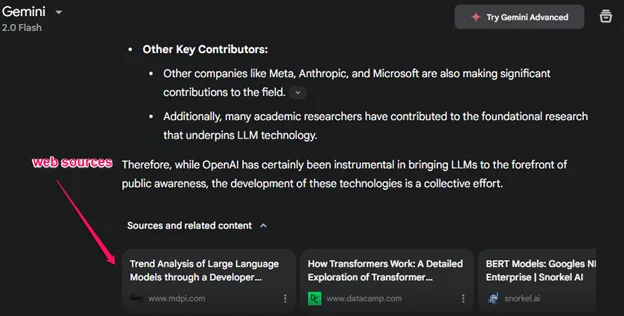
Gemini AI response with live data from the web
How to optimize for hybrid generative AI models? Simple. Do everything you did with other models above:
- Ensure your timeless content is comprehensive enough
- Keep updating said timeless content with new information and context as they become available.
- Stay on top of trending topics by sharing fresh insights about them.
LLM Optimization Strategies
As GEO is a rapidly evolving field, effective optimization tactics today might become obsolete tomorrow. However, an evidence-based study points to a few proven ways to optimize for GEO. That, and our current understanding of the nuances and differences between SEO and GEO, we recommend the following strategies:
1. Do Regular SEO for Google and Bing
Don’t throw out your SEO playbook. Many of the fundamentals of traditional SEO still matter in a generative search world. Search engines still crawl, index, and evaluate your content for authority, relevance, and quality. Generative systems often pull answers from top-ranking pages, especially those with high authority and clear structure.
Here’s what that means in practice:
- Technical SEO: make sure your site is crawlable and fast. If search engines can’t access your content, neither can generative AI systems.
- On-page SEO: use descriptive titles, clear headers (H1, H2, etc.), and focused content that directly addresses user intent.
- Topical authority: build clusters of high-quality content around specific subjects. LLMs tend to pull from pages that appear comprehensive and credible.
- Backlinks: while generative engines don’t show traditional link-based rankings, authority still matters. Pages with strong backlink profiles are more likely to be cited in AI-generated answers.
- Structured data: use schema markup where possible. It helps search engines and LLMs better interpret your content’s purpose and meaning.
According to Usman Akram, Organic Growth Strategist at Omniscient, “Brands can boost visibility in LLMs by increasing mentions across high-authority content, even without holding the top Google spot.”
He ran experiments with real B2B SaaS clients that validated his hypothesis. “Even if ClickUp is #1 on Google for ‘Project Management Software,’ LLM platforms will likely list Monday higher if it appears more across top-ranking pages.”
2. Build Entities Strategically
Generative search engines construct responses dynamically based on patterns in context, words, and entities. To drive visibility, these systems must recognize your brand, products, or associated key concepts as defined entities with clear properties and relationships.
One way to do this is to optimize for Google’s Knowledge Graph. Done well, this will improve your SEO share of voice and drive SERP visibility in rich snippets and knowledge panels.
To optimize for entities with generative AI in mind:
i. Clearly define your entities and their attributes
State what your entity is (your business, product, concept) and its key characteristics in multiple places. This could be on your About page, Home page, Google Business Profile (GBP), online directories, social media profiles, etc. This gives AI systems clear entity information, including your specialization, location, and industry focus.
ii. Create content that establishes relationships between entities
For your SEO agency, this might include relationships to:
- Locations — (headquartered in Austin, Texas, with clients nationwide)
- Services — (specializing in technical SEO and content strategy for SaaS eCommerce),
- Industry categories — (3x Speaker, MozCon and BrightonSEO)
- People — (founded by Sam Rivera, ex-Google)
Along with this, create comprehensive, authoritative content around semantic entities. Then reinforce these entities through strategic linking. This robust information and relationships help AI systems place your entity in a meaningful context.
iii. Build your online reputation through informative content about your main entities
Claim and verify your Google Business Profile and current listings for the Knowledge panel. Also, get listed and optimized on relevant social media and source websites like LinkedIn, Bloomberg, Wikipedia, etc.
iv. Use structured data markup when possible
Implement Schema.org or other structured data formats on your website. While generative AI doesn’t always directly read this data, it helps search engines and knowledge graphs that may feed into AI systems.
3. Optimize Content for Conversational Language and User Intent
Unlike traditional search engines, which might surface keyword-heavy pages, LLMs prioritize content that mirrors how people talk, ask questions, and expect answers. To stay relevant in generative search results, you need to write the way your audience thinks.
For example, instead of using “rank tracker for local SEO” keywords as an exact phrase, you should create content around question-based, long-tail keywords like, “What is the best rank tracker for a local SEO agency?” or “How to choose the best rank tracker for a local SEO agency?”.
You may even apply more context by getting specific on the industries you’re targeting and the organization’s size. You can tailor your variation to the questions potential customers are already asking on People Also Ask and platforms like Reddit and Quora.
So, rather than a broad keyword, you could have something like, “What’s the best local rank tracker for a small SEO agency of 50 people?”
Though pretty specific, it doesn’t overlook the main keyword. Instead, it added context that’ll enable you to provide in-depth answers for AI-generated summaries on Google AI Overviews or LLM-powered search engines.
Using latent semantic indexing keywords (LSI) also helps generative search engines associate the keyword entities in your content with the bigger picture — search intent.
4. Structure Your Content for Better User Experience and Engagement
Content isn’t just what you say; it’s how users experience it. This rings through for whatever type of content you create, whether SEO or GEO-optimized. It’s pretty much SEO 101.
What to do?
- Structure your content with H1s, H2s, and H3s to tackle specific pain points or subtopics deeply.
- Use bullet points to break up lists and enable skimming.
- Don’t skimp on visual cues, but don’t overdo it either.
- Vary your sentence lengths and make your paragraphs short.
- Incorporate other content formats, such as video, infographics, and tables, into your text. This will help explain concepts adequately.
To crown your efforts, prioritize logical flow to carry your readers along and give them a good reading experience.
5. Demonstrate EEAT
Even though E-E-A-T is an SEO concept, its principles are still technically aligned with what AI models value in content. So, when crafting content for AIO and LLM searches, demonstrate experience, subject matter expertise, authority, and trust.
Cite reputable sources, quotes, and statistics, and make sure the work is written (or at least reviewed) by a thought leader in the field.
Publish original research and insights, and include the data itself (not just the conclusions) in the content. This will strengthen the authority of your insights and inspire citations and mentions, helping you expand your GEO reach.
6. Don’t Forget Technical SEO
Like Google bots, AI-powered search engines should be able to crawl and understand your site if you want your content surfaced. Fortunately, regular technical SEO optimizations can work.
But to make your site and content truly AI-friendly, you need to pay attention to:
- **Speed and simplicity.**Your content should be optimized for fast load time and mobile responsiveness. According to Jed White’s post on Search Engine Land, “Many AI systems have tight timeouts (1-5 seconds) for retrieving content. Assume long content may be truncated or dropped completely after the timeout.”
- **Schema markup and metadata.**Clear descriptions, titles, dates, and structured data like HowTo schema and FAQ schema meta will help AI systems understand your content.
- Avoid blocking LLM crawlers. That said**,**most LLM crawlers struggle with rendering JavaScript. Therefore, use logical content structures in plain HTML or markdown, and also ensure you maintain a clean site architecture and your sitemap is up-to-date.
How to Measure Your Gen AI Optimization Efforts
Generative Engine Optimization (GEO) is still a moving target, and traditional SEO metrics don’t tell the full story. You won’t always see a traffic spike or a clear ranking boost, but that doesn’t mean your efforts aren’t working.
Instead of focusing solely on keyword rankings, GEO success is about visibility, citation, and influence within generative responses. Here’s how to measure it in practical, actionable ways:
1. Track AI-Search Visibility
Use Keyword.com’s AI visibility tracker to monitor your website’s appearance in LLM outputs and AI search results for Perplexity AI, Claude, ChatGPT, and more. Our AI brand mentions tool lets you:
- See exactly how your brand appears in AI search results and monitor position changes over time.
- Track competitor mentions for AI search queries
- Conduct AI sentiment analysis to know your overall brand perception
You can watch this video to learn more about our AI rank tracker features.
https://www.youtube.com/watch?v=uRIDkSTeISI
2. Measure Referral Traffic
Traffic, sessions, and conversions from generative engines on your website are the most useful measures of GEO results.
While traditional web analytics tools like Google Analytics may not directly track AI search traffic, they can help track the user journey to understand when traffic is initiated on AI search platforms and, therefore, pick it up as referral traffic.
Use the GA4 data to create custom reports that track time, AI platform conversions, AI platform traffic over time, AI platform sessions, and top GEO landing pages.
4. Track Brand Mentions
AI search tools constantly evolve, so tracking the frequency of brand mentions can be tricky. The data you collect can easily become outdated.
While there are a few ways to check brand mentions, they all have limitations. You can track backlinks and brand mentions across the web using SEMrush’s Backlink Analytics.
You may also directly search for your brand in AI engines/chatbots to see if and how you’re being mentioned. However, this is time-consuming, and the results can quickly become outdated as AI systems evolve.
Get the Full Picture of Your Search Visibility with Keyword.com
Generative AI is changing how users interact with search results. Being “on page one” doesn’t guarantee visibility anymore — not when AI Overviews, map packs, and instant answers are taking up more space.
Keyword.com gives you the best of both worlds:
- Traditional keyword ranking data
- AI visibility tracking across platforms like Google’s AI Overviews, Gemini, and ChatGPT
You also get insights into local map packs, featured snippets, share of voice, and your Google Business Profile — so you can see exactly where your brand is showing up (and where it’s not).
The result? A complete, accurate view of your search presence — and the data you need to optimize for both classic SEO and AI-powered results.
Ready to prepare for the feature of search? Sign up for Keyword.com and try our AI visibility tracker today.